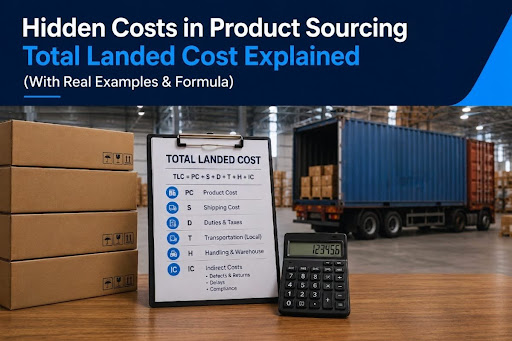
Total Landed Cost includes every expense required to move a product from the factory to your warehouse, such as shipping, duties, taxes, handling, and hidden costs like defects, delays, and compliance requirements. According to the World Bank’s Logistics Performance Index, logistics alone can account for up to 30% of total product cost, while poor quality can lead to 5%–20% losses due to defects and returns.
The issue is that many importers focus only on unit price and overlook these factors, leading to poor sourcing decisions.
This guide explains how Total Landed Cost works, how to calculate it, and where hidden costs typically appear, with real-world examples.
What Is Total Landed Cost?
Total Landed Cost is the total expense of importing a product, including product price, shipping, duties, taxes, and all additional costs required to deliver it to your final destination.
Total Landed Cost Formula
Total Landed Cost (TLC) = Product Cost + Shipping + Duties + Taxes + Insurance + Handling + Risk Costs
This includes:
- Manufacturing cost
- Freight (air, sea, rail)
- Import duties & taxes
- Customs clearance
- Warehousing & inland delivery
- Quality control & inspection
- Currency fluctuations
- Defects, delays, and returns
Typical Total Landed Cost by Industry
Total Landed Cost varies significantly depending on product type, shipping method, and compliance requirements.
Here’s a general benchmark:
| Industry | Typical TLC Increase |
|---|---|
| Electronics | 25%–45% |
| Apparel | 30%–60% |
| Furniture | 40%–80% |
| Industrial Equipment | 20%–40% |
These variations are driven by factors such as product size, regulatory requirements, and defect risk.
Why Total Landed Cost Matters in Product Sourcing
Understanding TLC changes how you make sourcing decisions.
1. Accurate Profit Margins
Without TLC, your margins are guesswork.
2. Better Supplier Selection
A higher unit price supplier can actually be cheaper overall.
3. Smarter Pricing Strategy
Prevents underpricing and margin erosion.
4. Risk Reduction
You account for delays, defects, and compliance issues upfront.
The Role of Incoterms in Landed Cost
One of the biggest gaps in most sourcing strategies is the misunderstanding of Incoterms (International Commercial Terms).
These define who pays for what in shipping.
Common Incoterms Explained:
EXW (Ex Works)
Buyer handles everything from factory onward → Lowest supplier price, highest buyer responsibility
FOB (Free On Board)
Supplier covers costs until goods are loaded onto the ship
CIF (Cost, Insurance, Freight)
Supplier includes shipping & insurance to the destination port
Why This Matters:
Choosing EXW vs FOB vs CIF can change your landed cost by 10–30%.
Example:
A “cheap” EXW quote may become expensive after adding logistics, export clearance, and handling.
Hidden Costs in Product Sourcing
Hidden costs are expenses that are not obvious upfront when sourcing a product but appear later across the supply chain, increasing your Total Landed Cost.
They are usually not included in the supplier’s quote, which is why many businesses underestimate their true cost.
The table below summarizes the key cost categories, what they include, and their impact on your Total Landed Cost.
| Cost Category | Key Components | Impact |
|---|---|---|
| Logistics | Transport (air/sea), fuel, congestion | Air transport can be 4–6x higher than ocean transport |
| Import & Compliance | Duties, VAT/GST, broker fees, HS codes | Errors increase cost and cause delays |
| Operations | Clearance, port fees, inland transport, storage | Required to move goods end-to-end |
| Quality | Inspections, audits, QC checks | 5–20% losses from defects (ASQ) |
| Financial | Currency shifts, transaction fees | Affects total spend on large orders |
| Time | Delays, stockouts, rush shipping | Leads to higher costs and lost sales |
| Returns | Replacements, reverse logistics | Raises per-unit cost |
| Risk | Defects, supplier issues, forecasting errors | Reduces margins if unmanaged |
Table: Key Components of Total Landed Cost in Product Sourcing
Real World Examples of Total Landed Cost
Case Study 1: Electronics Import (China to USA)
Initial Supplier Quote:
- Unit cost: $10
- Quantity: 1,000
- Total: $10,000
Additional Costs:
- Ocean shipping: $1,800
- Import duty (10%): $1,000
- Customs clearance: $300
- Inspection: $250
- Inland transport: $400
- Warehousing: $200
Final Calculation:
- Total Landed Cost = $13,950
- Cost per unit = $13.95
- Hidden cost increase: +39.5%
Case Study 2: Apparel Business (Air Freight Mistake)
Supplier Cost:
- $5 per unit
- 2,000 units = $10,000
What Went Wrong:
- Delay forced air shipping: $4,000
- Duties & taxes: $1,500
- 8% defects: $800 loss
- Returns: $300
Final Result:
- Total Cost = $16,600
- Per Unit = $8.30
- Delivery decision alone increased cost by 66%+
Case Study 3: Choosing the Wrong Supplier
| Factor | Supplier A | Supplier B |
|---|---|---|
| Unit Price | $8 | $9 |
| Defect Rate | 10% | 2% |
| Inspection | No | Yes |
Outcome:
- Supplier A real cost: $10.50+
- Supplier B real cost: $9.80
The cheapest supplier became the most expensive.
Step-by-Step: How to Calculate Total Landed Cost
Here’s a practical framework used by sourcing professionals:
Step 1: Product Cost
Unit price × quantity
Step 2: Shipping Costs
Shipment + insurance
Step 3: Import Costs
Duties + taxes
Step 4: Operational Costs
Customs + handling + documentation
Step 5: Post-Arrival Costs
Warehousing + delivery
Step 6: Risk Adjustments
Defects + delays + returns
Tools & Software for Landed Cost Calculation
To improve accuracy, many businesses use:
- ERP systems (NetSuite, SAP)
- Freight calculators
- Customs duty databases
- Landed cost calculators (Excel or SaaS tools)
Even a simple spreadsheet model can significantly improve decision-making.
Country-Specific Considerations (Global Buyers)
Different regions have different cost structures:
USA:
- Moderate duties
- Strict compliance (FDA, FCC)
EU:
- High VAT
- Strong regulatory standards (CE marking)
UK / Australia / Canada:
- Similar import frameworks with local tax variations
Understanding destination-specific rules helps avoid unexpected compliance costs.
How to Reduce Total Landed Cost (Without Cutting Quality)
Reducing Total Landed Cost is all about making smarter, more efficient decisions across your supply chain.
1. Optimize Your Shipping Strategy
Plan shipments in advance to avoid expensive air transportation. Use ocean shipping where possible and consolidate orders to reduce per-unit cost.
2. Choose the Right Incoterms
Using FOB instead of EXW can shift logistics responsibility to the supplier and reduce unexpected handling costs.
3. Work with Reliable Suppliers
A slightly higher unit price with a reliable supplier often results in lower overall cost due to fewer defects, delays, and inconsistencies.
4. Invest in Quality Control
Pre-shipment inspections and factory audits help prevent costly returns, replacements, and brand damage.
5. Improve Packaging Efficiency
Optimizing packaging size and weight reduces delivery charges, especially for air and container shipping.
6. Classify Products Correctly (HS Codes)
Accurate classification ensures you pay the correct duties and avoid penalties or overpayment.
7. Forecast Demand More Accurately
Better planning reduces the need for urgent shipments and minimizes storage or stockout costs.
8. Consolidate Shipments
Combining multiple orders into a single shipment lowers per-unit shipping and handling costs.
To further reduce costs and improve efficiency, explore strategies to achieve cost-effective procurement as part of a structured sourcing approach.
When to Seek Professional Support in Product Sourcing
Managing Total Landed Cost goes beyond calculations; it requires control over suppliers, quality, logistics, and compliance.
When You Need Support
- Sourcing from new markets
- Facing defects, delays, or hidden costs
- Scaling operations
- Lacking supplier visibility
What Experts Help With
- Supplier audits and verification
- Quality inspections
- Production monitoring
- Compliance and logistics support
SIXMexico works with global buyers across manufacturing, retail, and industrial sectors, helping businesses reduce risk and control Total Landed Cost more effectively.
Choosing the right partner is just as important as managing costs. Learn how to choose a product sourcing company to make better decisions.
Take Control of Your Total Landed Cost with SIXMexico
Hidden costs don’t have to erode your margins. With the right systems, visibility, and on-ground expertise, you can turn sourcing into a predictable and profitable process.
SIXMexico provides end-to-end product sourcing services in Mexico, helping you identify reliable suppliers, ensure consistent quality, and manage logistics with full visibility.
From supplier verification and factory audits to inspections and production monitoring, SIXMexico helps you reduce hidden costs and make confident sourcing decisions.
Get in touch with SIXMexico to strengthen your supply chain, improve product quality, and protect your margins with confidence.
Frequently Asked Questions (FAQ)
What is the total landed cost?
Total landed cost is the full cost of importing a product, including product price, shipping, duties, taxes, and all additional fees until it reaches your warehouse.
What is not included in landed cost?
It usually excludes marketing costs, platform fees (Amazon, Shopify), and internal business expenses like salaries or rent.
Which Incoterm is best for buyers?
FOB is commonly preferred because it gives buyers more control over shipping while keeping supplier responsibility balanced.
What is the biggest cost driver in landed cost?
Freight is usually the highest and most unpredictable cost, especially with air shipping.
What is an HS code, and why is it important?
An HS code is a product classification used globally to calculate import duties. Incorrect codes can lead to higher costs or penalties.
How does product size affect landed cost?
Larger products increase logistics costs due to volumetric weight and also raise storage and handling expenses.
Why do freight costs fluctuate so much?
Shipment rates change due to fuel prices, seasonal demand, port congestion, and global supply chain conditions.
How do delays increase landed cost?
Delays can lead to storage fees, urgent shipping upgrades, and lost sales opportunities.
Should I include defect rates in landed cost?
Yes, including expected defects gives a more realistic cost per unit and protects your margins.
How do exchange rates affect landed cost?
Currency fluctuations can increase or decrease your total cost, especially in large international transactions.
Can landed cost vary between shipments?
Yes, it changes based on shipping rates, shipping method, order size, and timing.
What is the difference between landed cost and total cost?
Landed cost covers import-related expenses, while total cost includes marketing, operations, and selling expenses.
When should I calculate landed cost?
Before selecting a supplier, setting prices, or placing large orders, to avoid unexpected costs.
Do I need a landed cost calculator?
Not required, but highly useful for improving accuracy and decision-making.