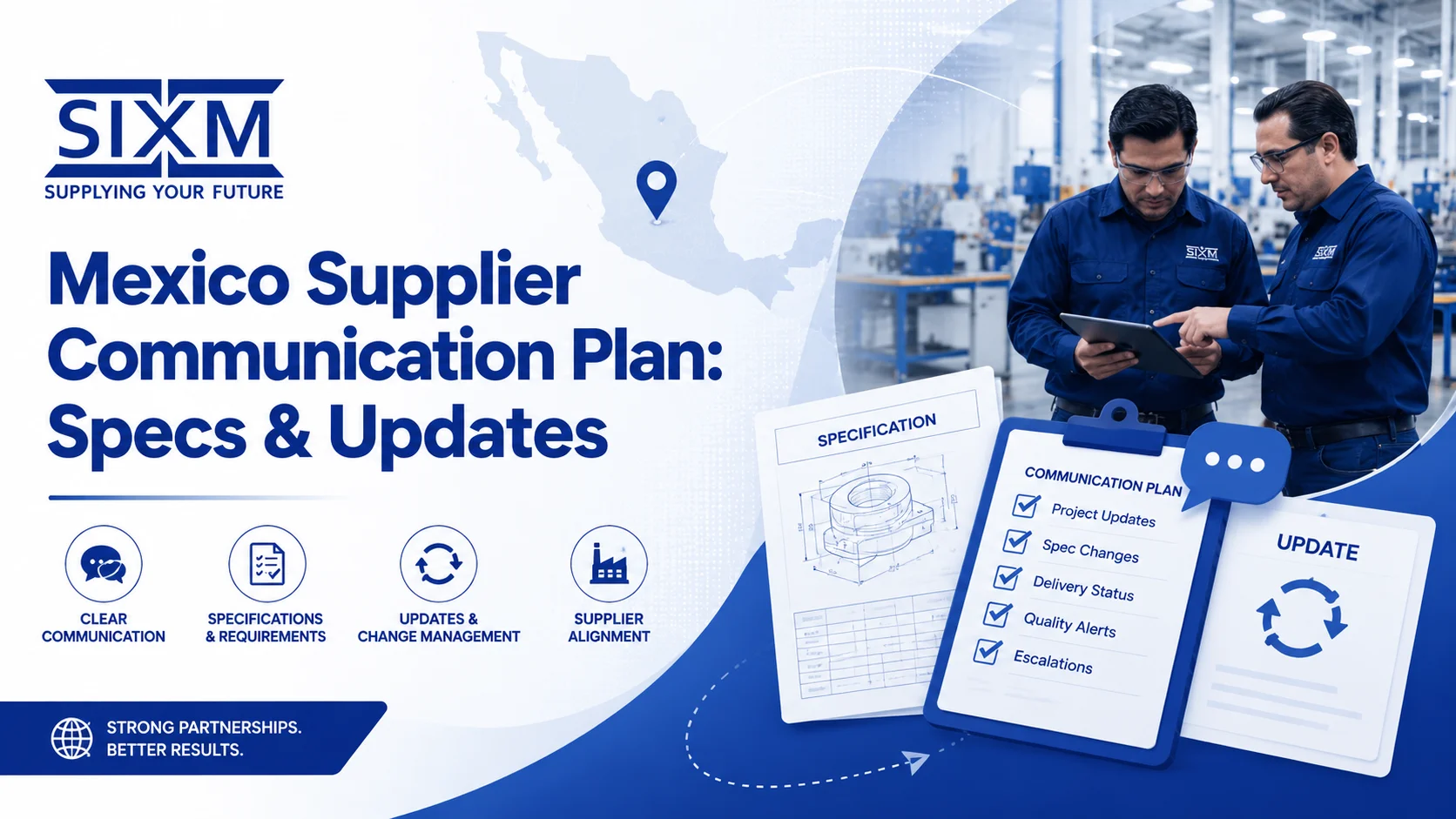
A Mexico supplier communication plan works when it has three parts: a bilingual spec document that both teams edit from a single shared file, a written change control process tied to your purchase order, and a weekly production update that reports real numbers, not just a status call. Together, these three pieces remove the guesswork that causes most quality and delivery failures in sourcing from Mexico.
This guide shows you exactly how to build each part, with templates, checklists, and the tools to run it without added software overhead.
Why a Communication Plan Matters More in Mexico Than Buyers Expect
Many Mexican manufacturers have English-speaking staff on the floor. That fact alone leads a lot of buyers to assume communication will take care of itself. It does not. Technical specifications, tolerances, and quality standards get lost in translation even when both sides are fluent, because casual conversational English is not the same as precise engineering language.
A tolerance written as "approximately 2mm" means something different to a Spanish-speaking machinist than it does to a US-based product designer. Spec sheets written only in English also tend to get re-interpreted informally on the shop floor, often by someone who never saw the original document.
A complete Mexico supplier communication plan has to address this at three levels: the documents that define the product, the process that governs changes to those documents, and the reporting rhythm that confirms the floor is actually following them.
Common breakdown points include:
- Relative language in specs such as "slightly larger" or "tight fit" that has no fixed meaning across languages
- Verbal approvals given on phone calls with no written record
- Specs translated once and never updated alongside revisions
- Shop floor staff working from a verbal summary instead of the original document
- Assumptions that bilingual staff on a call means bilingual documentation exists
A Real Example of What This Costs
One mid-size electronics buyer working with a Tier 2 supplier in Guadalajara approved a connector substitution over a phone call, with the change confirmed verbally in English to a sales contact who then relayed it informally to the production line in Spanish. The line interpreted the substitution as applying to the entire run instead of one specific batch. The result was 4,200 units built to the wrong spec, a six-week delay, and a rework cost that erased the margin on that order. A one-page bilingual change notice with a signature line and a clear batch reference would have prevented it entirely.
This is the type of gap a structured communication plan is built to close.
Pillar One: Build Bilingual Specification Documents From Day One
Every technical document that governs your product should exist in both English and Spanish, side by side, not as two separate files maintained independently. This includes drawings, tolerance tables, packaging instructions, material callouts, and acceptance criteria.
McKinsey's Global Supply Chain Leader Survey found that nine in ten supply chain executives encountered supply chain challenges in 2024, with comprehensive visibility into tier-one suppliers reaching only 60 percent of companies surveyed. Visibility gaps like this are exactly what bilingual, written documentation is meant to close
Structure That Prevents Misreads
A well-built bilingual spec document should include:
- English and Spanish text in parallel columns on the same page, not separate translated files
- Numbered callouts on drawings instead of long paragraphs of prose
- Numeric tolerance ranges for every dimension, never relative terms
- A single version-controlled master file that both sides reference during calls and inspections
- Photos or reference samples attached directly to the spec, since images need no translation
Replace words like "slightly larger" or "tight fit" with exact measurements and acceptable deviation. This single habit eliminates a large share of the disputes that come up later in production.
Bilingual Spec Sheet Template
| Field | English | Español |
|---|---|---|
| Part number | ||
| Dimension and tolerance | ||
| Material and grade | ||
| Surface finish | ||
| Acceptance criteria | ||
| Packaging requirement | ||
| Revision number and date |
Keep this as one shared file, not two separate documents. Both teams editing the same source eliminate version drift.
Who Should Translate Your Specs
- Avoid machine translation for anything affecting dimensions, materials, or safety
- Use a bilingual engineer, not a general language translator, for technical content
- Have a sourcing partner with manufacturing background review the spec before it reaches the floor
- Re-confirm translated terminology directly with the line supervisor, not just the sales contact
Pillar Two: Set Up a Formal Change Control Process
Specifications change. New tooling gets approved, a material substitution gets requested, a customer asks for a packaging update. The problem is not that changes happen. The problem is that most buyer-supplier relationships in Mexico handle changes through informal WhatsApp messages or a verbal agreement on a phone call, with no paper trail and no link back to the purchase order it affects.
The exposure is real even outside regulated industries. Deloitte's manufacturing supply chain study found that 88 percent of surveyed executives have concerns about legal, financial, or operational risk stemming from their supply chain ecosystem, a risk that grows sharply when changes to specs or materials happen without a documented, signed-off record. A one-page change notice costs nothing by comparison.
Tie Every Change to the Purchase Order
A change control document is not just an internal memo; it needs to be legally and operationally connected to the PO governing that production run. Before a change takes effect, confirm:
- Which PO number and line item does the change apply to
- Whether the change affects unit pricing, lead time, or quantity terms already agreed in the PO
- Whether the supplier's standard contract requires a written amendment for spec changes, not just verbal confirmation
- That the signed change notice is filed alongside the PO, not in a separate email thread
Skipping this step is how buyers end up with a supplier who built to a new spec but still invoices and expects payment, under the original PO terms.
Minor Change vs Major Change: A Simple Decision Flow
Not every change needs the same level of scrutiny. A useful way to triage:
- Minor change (packaging label update, color tweak with no functional impact): documented in writing, single approver sign-off, applied at next batch start
- Major change (dimensional tolerance, material substitution, supplier or sub-supplier swap): requires a bilingual change notice, dual sign-off from buyer and supplier, updated PO reference, and a first-article inspection before full batch production resumes
Treating every change as minor is how the Guadalajara example above happened. Treating every change as major slows down legitimate small fixes. The triage step is what most buyers skip entirely.
What a Change Control Document Should Include
Every engineering change notice should capture:
- The exact change requested and the reason behind it
- Whether it is classified as minor or major, using the triage above
- Who approved it on the buyer side, and who approved it on the supplier side
- The effective date, the production run, and the related PO number
- Reference to the original spec section being revised
- Sign-off from both parties before the change reaches the line
Change Notice Checklist
- Change the description written in both languages
- Affected SKU, lot or batch number, and PO reference specified
- Buyer approver name and date
- Supplier approver name and date
- Effective date clearly marked as "starting this batch" or "starting this date"
- Old spec version archived, not deleted, for audit purposes
Building an Approval Chain
- Define who on your team has authority to approve a change
- Define who on the supplier side has authority to implement it, this should never default to a line supervisor without escalation
- Communicate this chain at the start of the relationship, not after a problem occurs
- Keep a running change log per SKU as your audit trail and onboarding reference
Pillar Three: Structure Your Weekly Production Updates
Weekly check-ins get mentioned constantly in sourcing advice, but very few sources explain what should actually be in that update. A vague status call where the supplier says production is "on track" gives you almost no usable information.
What a Useful Weekly Update Should Report
- Current production stage by SKU
- Units completed against units planned for the week
- Any material delays from sub-suppliers
- Open quality issues and their resolution status
- Confirmed ship date versus original ship date
- Photos or short videos of work in process for higher value or higher complexity orders
This should arrive as a written report, not just a verbal call, so you have a record to compare week over week.
Weekly Report Template
| Field | This Week's Entry |
|---|---|
| SKU | |
| Production stage | |
| Units completed vs planned | |
| Material or sub-supplier delays | |
| Open quality issues | |
| Ship date (confirmed vs original) | |
| Photo/video attached (Y/N) |
Cadence, Format, and Ownership
- Weekly is the right rhythm for active production runs
- Monthly is too slow to catch a developing delay before it becomes unrecoverable
- Daily is usually unnecessary overhead for both sides
- Use one standard template every week so the same data points are comparable over time
- Assign one named owner on each side responsible for sending and reviewing the report, not a shared team inbox
If two consecutive weekly updates are missed or come back vague, treat it as an early warning sign and escalate to your local sourcing or quality control contact immediately rather than waiting for the next cycle.
KPIs to Measure If Your Communication Plan Is Working
A communication plan works best when it produces numbers you can track over time, not just documents and calls. Three metrics are enough to start:
- PPM defect rate, parts per million found defective, tracked per SKU per shipment
- On-time delivery rate, percentage of shipments hitting the confirmed ship date from the weekly report
- Change notices per quarter, a rising count on one SKU often signals a spec or sourcing problem worth a deeper review
Review these three numbers monthly alongside the supplier. A bilingual spec process and a clean change control log are what keep these numbers accurate in the first place, since a change that was never documented properly will quietly distort your defect and delivery data.
Tools and Platforms to Run Your Mexico Supplier Communication System
You do not need expensive software to run this system well. What matters is consistency, not the platform.
- Shared drive or cloud folder (Google Drive, Dropbox, OneDrive) for the master bilingual spec file and the change log, so both sides are always editing the same source document rather than emailing versions back and forth
- A simple spreadsheet or lightweight project tracker (Google Sheets, Airtable, Trello) for the weekly production update, one row per SKU per week, so you can scroll back and compare trends without digging through email threads
- WhatsApp Business or a dedicated messaging channel for daily quick questions, but never for approving a spec change, that always goes through the written change notice
- Email with a fixed subject line format (example: "CHANGE NOTICE, SKU 1042, Batch 14") so change documentation is searchable later instead of buried in a generic thread
- A shared calendar invite for the weekly update call, recurring and fixed, so it does not get rescheduled informally and skipped
The platform matters far less than the rule behind it: documentation lives in one shared place, decisions get written down, and nothing important gets approved inside a chat app. A sourcing partner with a manufacturing background can help set this up once and keep both sides using it consistently, rather than letting it drift back into informal channels after the first few weeks.
What a Complete Mexico Supplier Communication Plan Requires That Generic Advice Misses
A complete Mexico supplier communication plan needs all three pillars working together, supported by numbers you actually track. Bilingual documentation without change control still leaves room for an undocumented spec change to slip through. Change control without weekly reporting still leaves you blind to whether the floor is actually building to the latest approved spec. Weekly reporting without bilingual source documents just means you get a status update on a process that may already be running off a misread spec.
Why These Three Pillars Cannot Work in Isolation
This is the part that gets missed most often: communication advice tends to treat these as separate best practices rather than one connected system.
- "Hold regular meetings" is common advice, but a meeting without a written report is just a conversation
- "Use bilingual staff" is common advice, but bilingual staff without bilingual documents still leaves the floor working from a verbal summary
- "Put it in writing" is common advice, but a change written down with no PO reference and no triage logic still leaves room for a buyer and supplier to disagree about what they actually agreed to
How the Three Pillars Should Reference Each Other
The pillars only work as protection when they connect back to one another:
- A weekly update should flag whether a change notice is pending
- A change notice should reference the exact spec section and PO line it modifies
- A spec document should carry a revision number that ties back to the change log, so anyone picking up the file later knows exactly which version is current and why
What This Prevents
Treating these as one system, rather than three unrelated habits, is what actually prevents the kind of failure described earlier in this guide, where a verbal approval to one contact turned into a six-week delay and a full batch rebuild. None of the three pillars alone would have stopped that outcome. All three together would have.
If you're working to control costs alongside building this communication structure, our guide on effective ways to reduce manufacturing costs covers practical strategies that pair well with a tighter supplier process.
Build a Mexico Supplier Communication Plan That Actually Holds Up
A bilingual spec sheet, a change control process tied to your purchase order, and a weekly production report tracked against real KPIs are not separate projects. They are one system, and most sourcing problems in Mexico trace back to a gap somewhere in that system rather than a single bad supplier.
This is exactly what SIXM's supplier management services are built around: bilingual documentation, formal change control, and weekly oversight handled by a local team that represents your interests directly with the supplier, so nothing gets lost between a phone call and the production line.
If you are sourcing from Mexico and want this structure in place before your next production run starts, not after a costly mistake forces the issue, talk to SIXM about supplier management for your project.
Frequently Asked Questions
Do I need bilingual documentation if my supplier's sales contact speaks fluent English?
Yes. The sales contact is rarely the person executing on the production line. Documentation needs to reach the machinist, the quality inspector, and the line supervisor directly, and that only works if it exists in Spanish as well as English.
How often should a change control document be updated?
Every time a spec changes, no matter how minor it seems. Use the minor versus major triage to decide the level of sign-off required, but document every change regardless of size.
What is the difference between a weekly check-in call and a weekly production update?
A check-in call is verbal and easy to forget or misremember. A weekly production update is a written report with specific data points, stage, units completed, delays, and ship date that creates a comparable record over time.
Does a change control document need to reference the purchase order?
Yes. A change that is not tied back to the PO governing that run creates a mismatch between what the supplier built and what they are contractually entitled to invoice for.
Can I manage this communication system myself, or do I need a local partner?
It is possible to manage directly if you have bilingual technical staff and time to dedicate to weekly oversight. Many buyers use a local sourcing partner specifically because it removes the language and oversight burden from their internal team.
What is the fastest way to start if I already have an active supplier relationship?
Begin with the change control document and PO reference check. It is the highest-risk gap and the easiest to implement immediately, since it only requires a one-page bilingual template and a signature from both sides before any new change takes effect.