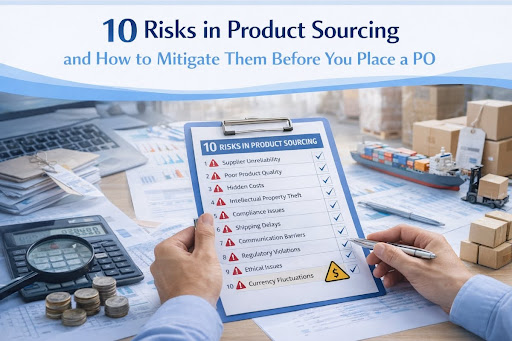
Product sourcing risks such as supplier unreliability, poor product quality, hidden costs, compliance issues, and shipping delays can significantly impact business operations if not addressed early. These risks can be reduced by verifying supplier credibility, defining detailed product specifications, calculating total landed costs, protecting intellectual property, and ensuring regulatory compliance before production begins.
According to global supply chain research, nearly 80% of organizations experienced at least one supply chain disruption in the past year, emphasizing the importance of proactive risk management before placing large purchase orders. This guide explains 10 key risks in product sourcing, along with practical steps to mitigate them before placing a purchase order.
Common Risks in Product Sourcing
Product sourcing involves multiple stages, from supplier selection and product development to manufacturing and logistics. At each stage, different challenges can arise that may affect product quality, cost, or delivery timelines. Understanding the most common sourcing risks helps businesses identify potential problems early and implement preventive strategies before placing a purchase order.
1. Supplier Reliability Risk
One of the most common sourcing risks is partnering with an unreliable supplier.
Many suppliers appear legitimate during initial discussions but fail to deliver on promises related to product quality, production timelines, or communication. In extreme cases, buyers fall victim to fraudulent suppliers.
Common warning signs
- Slow or inconsistent communication
- Unwillingness to provide documentation
- Poor understanding of product requirements
- Pressure to pay deposits quickly
- No verifiable business history
Mitigation
Before placing a purchase order, conduct proper supplier verification.
Key steps include:
- Verify company registration documents
- Check export licenses and certifications
- Review trade history and customer references
- Request product samples before bulk production
- Conduct factory audits when possible
Using sourcing platforms or third-party inspection companies can also help verify supplier legitimacy.
Building a long-term relationship with reliable suppliers reduces risk and improves supply chain stability.
2. Product Quality Risk
A survey of sourcing professionals found that 65% of buyers identified product quality as a major challenge when sourcing from new suppliers or regions, showing that quality control remains one of the biggest risks in global procurement. Poorly manufactured products can lead to returns, refunds, negative reviews, and brand damage.
Even when suppliers provide samples that meet expectations, mass production quality can differ significantly.
Causes of quality problems
- Poor raw materials
- Lack of production standards
- Miscommunication about specifications
- Subcontracted manufacturing
- Inadequate quality control
Mitigation
Quality must be controlled throughout the production cycle.
Recommended steps include:
- Provide clear product specifications and technical drawings
- Create a product specification sheet
- Define acceptable quality standards
- Use approved samples as production benchmarks
- Conduct During Production Inspections (DUPRO)
- Perform Pre-Shipment Inspections (PSI)
These inspections help identify defects early, allowing corrective action before shipment.
3. Hidden Cost Risk
Many businesses calculate product cost based only on supplier pricing. However, sourcing involves multiple hidden costs that can significantly increase the final landed cost.
Common hidden costs
- Shipping and freight charges
- Customs duties and taxes
- Inspection fees
- Packaging costs
- Warehousing expenses
- Currency fluctuations
Failing to account for these costs can destroy profit margins.
Mitigation
Before placing a purchase order:
- Calculate total landed cost
- Compare FOB vs CIF pricing
- Estimate import duties and tariffs
- Factor in logistics and customs clearance costs
Working with freight forwarders early in the sourcing process helps estimate shipping expenses accurately.
Understanding the full cost structure ensures accurate pricing and profitability.
4. Communication and Specification Risk
Miscommunication between buyers and suppliers is a major cause of sourcing failures.
Language barriers, cultural differences, and vague product requirements often lead to incorrect production.
For example, a small misunderstanding in dimensions, materials, or packaging can result in thousands of unusable units.
Examples of specification mistakes
- Incorrect product measurements
- Wrong material or components
- Improper packaging design
- Missing accessories
- Incorrect labeling
Mitigation
Clear documentation is essential.
Best practices include:
- Provide detailed product specifications
- Use technical drawings and images
- Confirm materials and components in writing
- Request production samples
- Create a Product Requirement Document (PRD)
Maintaining written confirmation of every detail reduces the chance of costly misunderstandings.
5. Intellectual Property Risk
Product sourcing can expose businesses to intellectual property (IP) theft.
Suppliers may copy your product design, sell it to competitors, or produce unauthorized versions of your product.
This is particularly common in industries such as electronics, fashion, and consumer goods.
Examples of IP risks
- Product designs copied and resold
- Private label products sold to other buyers
- Trademark violations
- Counterfeit production
Mitigation
Protecting intellectual property requires proactive measures.
Key strategies include:
- Register trademarks in manufacturing countries
- Use Non-Disclosure Agreements (NDAs)
- Use Non-Compete Agreements
- Work with trusted suppliers only
- Avoid sharing complete designs with multiple factories
Businesses should also monitor marketplaces to detect unauthorized copies of their products.
6. Compliance and Regulatory Risk
Every country has regulations that govern product safety, labeling, and certifications.
Failure to meet these requirements can lead to:
- Customs seizures
- Product recalls
- Legal penalties
- Sales bans
Common regulatory requirements
- CE certification (Europe)
- FCC certification (electronics)
- FDA regulations (food and medical products)
- CPSIA compliance (children’s products)
Mitigation
Before placing a purchase order:
- Research product regulations in the destination country
- Verify supplier certifications
- Request compliance test reports
- Conduct laboratory testing if required
Working with compliance experts or testing laboratories ensures products meet regulatory standards.
7. Production Delay Risk
Production delays can disrupt product launches, inventory availability, and sales cycles.
Delays may occur due to:
- Raw material shortages
- Production scheduling conflicts
- Factory capacity limitations
- Labor shortages
- Equipment failures
For seasonal products or promotional campaigns, delays can cause significant financial loss.
Mitigation
To reduce production delays:
- Confirm production capacity before placing orders
- Establish realistic production timelines
- Include delivery deadlines in contracts
- Monitor production progress regularly
- Work with backup suppliers when possible
Many experienced importers also stagger orders across multiple suppliers to reduce dependency.
8. Logistics and Shipping Risk
Even after successful production, shipping problems can disrupt supply chains.
Common logistics risks include:
- Port congestion
- Shipping delays
- Container shortages
- Damaged goods during transit
- Incorrect shipping documentation
Global disruptions such as pandemics, trade restrictions, or geopolitical tensions can also affect shipping timelines.
Mitigation
Businesses should plan logistics early.
Effective strategies include:
- Working with experienced freight forwarders
- Choosing reliable shipping routes
- Using appropriate packaging for protection
- Purchasing cargo insurance
- Verifying shipping documentation
Tracking shipments and maintaining communication with logistics partners helps minimize delays.
9. Payment and Financial Risk
International sourcing often requires partial or full payment before receiving goods.
This creates financial risk for buyers, particularly when working with new suppliers.
Common payment risks include:
- Suppliers failing to ship after receiving payment
- Poor product quality despite payment
- Currency exchange losses
- Fraudulent suppliers
Mitigation
Several payment methods can reduce risk:
- Letter of Credit (LC)
- Escrow payment services
- Partial deposit with balance after inspection
- Trade assurance programs
Avoid sending full payments upfront, especially when working with new suppliers.
Negotiating payment terms can significantly reduce exposure.
10. Supply Chain Disruption Risk
Studies show that 94% of companies report revenue impacts due to supply chain disruptions, highlighting how sourcing risks such as supplier delays or logistics failures directly affect business performance.
Unexpected events such as natural disasters, geopolitical conflicts, or pandemics can interrupt manufacturing and shipping.
Businesses relying on a single supplier or region face higher risk.
Mitigation
Diversification is the key to supply chain resilience.
Strategies include:
- Sourcing from multiple suppliers
- Using suppliers in different regions
- Maintaining safety stock
- Developing alternative logistics routes
Businesses are increasingly exploring China+1 strategies, sourcing from countries such as Vietnam, India, and Mexico to reduce dependency on a single manufacturing hub.
Best Practices Before Placing a Purchase Order
Before committing to a purchase order, businesses should conduct a thorough sourcing evaluation.
Essential pre-PO checklist
- Verify supplier credentials
- Approve product samples
- Confirm product specifications
- Conduct factory audits if necessary
- Define quality standards
- Estimate total landed cost
- Review compliance requirements
- Establish payment terms
- Schedule inspections
- Plan logistics and shipping
Following this checklist significantly reduces sourcing risks.
Understanding the strategic sourcing process can also help businesses plan procurement more effectively and minimize sourcing risks before placing a purchase order.
The Importance of Quality Control in Sourcing
Quality control plays a crucial role in minimizing sourcing risks. Professional inspection services help verify:
- Product quality
- Quantity accuracy
- Packaging standards
- Labeling compliance
- Functionality testing
Common inspection types include:
Pre-Production Inspection
Checks raw materials and production readiness before manufacturing begins.
During Production Inspection (DUPRO)
Evaluates product quality while manufacturing is in progress.
Pre-Shipment Inspection (PSI)
Confirms final product quality before shipment.
These inspections help ensure that goods meet buyer expectations and reduce the risk of costly defects.
To better understand the fundamentals of sourcing, explore our guide on what product sourcing is and how it works before diving deeper into the risks involved.
Building Long-Term Supplier Relationships
Successful sourcing is not just about finding the lowest price. Strong supplier relationships improve:
- Product consistency
- Communication
- Production priority
- Problem resolution
Businesses should treat suppliers as long-term partners rather than one-time vendors. This approach encourages transparency, collaboration, and continuous improvement.
Simplify Product Sourcing in Mexico with SIXM
Product sourcing can drive growth and cost efficiency, but it also comes with risks. Identifying these risks early and implementing mitigation strategies helps businesses avoid costly mistakes before placing a purchase order.
For companies looking to source products in Mexico, working with a trusted local partner can make the process smoother and more reliable. SIXM offers professional product sourcing services in Mexico, helping businesses identify verified manufacturers, manage quality control, and streamline production and logistics.
Contact SIXM today to simplify your sourcing process and connect with reliable suppliers in Mexico.