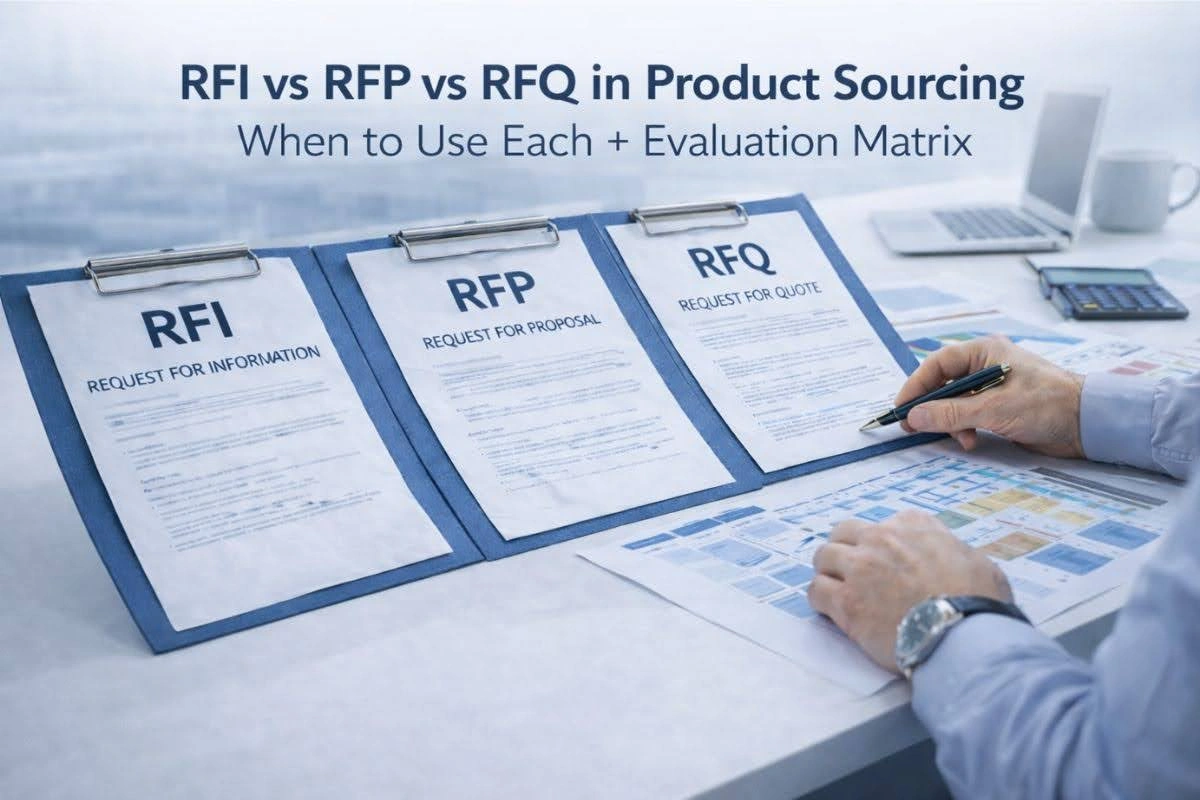
RFI vs RFP vs RFQ are essential procurement tools, but they serve very different purposes in the sourcing process. An RFI (Request for Information) gathers supplier capability data, an RFP (Request for Proposal) evaluates detailed solutions, and an RFQ (Request for Quotation) focuses on pricing for defined specifications. Understanding when to use each document helps reduce risk, improve supplier alignment, and control costs.
This guide explains the differences between RFI, RFP, and RFQ, when to use each in product sourcing, and how to evaluate suppliers using a practical, weighted evaluation matrix.
What Is an RFI (Request for Information)?
An RFI is used during the exploratory phase of sourcing when you need information about supplier capabilities, technologies, production capacity, certifications, or market options.
When to Use an RFI
Use an RFI when:
- You are entering a new market
- You lack technical clarity
- You need to shortlist suppliers
- You want to understand manufacturing capabilities
- You are conducting supplier prequalification
RFI Characteristics
- High-level questions
- No pricing request (usually)
- Short response format
- Used to narrow vendor pool
- Focus on capability and experience
Example RFI Questions
- What certifications do you hold (ISO, ESG, quality standards)?
- What is your annual production capacity?
- Which markets do you currently serve?
- What quality control systems are implemented?
- Can you provide references?
Advantages of RFI
- Reduces risk early
- Helps understand supplier landscape
- Filters unqualified vendors
- Improves later RFP quality
Limitations
- No binding pricing
- High-level responses
- May require follow-up clarification
What Is an RFP (Request for Proposal)?
An RFP is used when you understand your business need but want suppliers to propose how they would meet it.
It is ideal for complex, customized, or strategic sourcing projects.
When to Use an RFP
Use an RFP when:
- The project is complex
- Technical solutions vary
- You need innovation
- Multiple approaches are possible
- You want structured evaluation criteria
RFP Characteristics
- Detailed scope of work
- Timeline expectations
- Technical requirements
- Evaluation criteria
- Commercial terms
- Often includes pricing component
Example RFP Components
- Project overview
- Scope of work
- Technical specifications
- Deliverables
- Timeline
- Compliance requirements
- Proposal format instructions
- Evaluation criteria
Advantages of RFP
- Encourages innovation
- Structured comparison
- Reduces ambiguity
- Improves supplier accountability
Limitations
- Time-consuming
- Requires detailed preparation
- Complex evaluation process
What Is an RFQ (Request for Quotation)?
An RFQ is used when specifications are clear and standardized, and the main differentiator is price.
It is most common in manufacturing and product sourcing.
When to Use an RFQ
Use an RFQ when:
- Product specifications are fixed
- You know the required quantity
- Quality standards are defined
- Delivery timelines are clear
- You are ready to purchase
RFQ Characteristics
- Exact technical specifications
- Quantity requirements
- Delivery schedule
- Pricing format
- Payment terms
Example RFQ Fields
- Unit price
- Tooling cost
- MOQ (Minimum Order Quantity)
- Lead time
- Shipping terms (FOB, CIF, DDP)
- Payment terms
Advantages of RFQ
- Fast decision-making
- Price transparency
- Easy comparison
- Suitable for commoditized goods
Limitations
- No flexibility
- No innovation
- Price-focused competition
Key Differences Between RFI, RFP, and RFQ
Although RFI, RFP, and RFQ are often grouped, they serve distinct purposes in procurement. Understanding their differences helps ensure the right document is used at the right time.
1. Purpose
- RFI (Request for Information): Collects market intelligence and supplier capability data.
- RFP (Request for Proposal): Requests detailed technical and commercial solutions.
- RFQ (Request for Quotation): Obtains pricing for clearly defined specifications.
2. Stage in the Sourcing Process
- RFI: Early research and supplier prequalification stage.
- RFP: Solution development and evaluation stage.
- RFQ: Final pricing and commercial negotiation stage.
3. Level of Detail Required
- RFI: High-level capability information.
- RFP: Detailed scope of work, timelines, compliance requirements, and solution approach.
- RFQ: Exact technical specifications, quantities, and delivery terms.
4. Pricing Involvement
- RFI: Typically does not request pricing.
- RFP: May include indicative or structured pricing.
- RFQ: Focuses primarily on pricing and commercial terms.
5. Evaluation Focus
- RFI: Capability, certifications, experience, and financial stability.
- RFP: Technical solution, innovation, quality systems, risk mitigation, total cost.
- RFQ: Unit price, lead time, payment terms, cost competitiveness.
Side-by-Side Comparison of RFI, RFP, and RFQ
Although RFI, RFP, and RFQ are often mentioned together, they serve different functions within the sourcing lifecycle. Choosing the correct document depends on project complexity, clarity of specifications, and decision priorities.
Below is a structured comparison to clarify their differences:
| Factor | RFI | RFP | RFQ |
|---|---|---|---|
| Primary Purpose | Gather supplier information | Evaluate detailed solutions | Compare pricing |
| Stage in Process | Research & prequalification | Solution development | Final commercial negotiation |
| Pricing Included | No | Sometimes | Yes |
| Complexity Level | Low | High | Low |
| Innovation Potential | Minimal | High | Minimal |
| Decision Driver | Capability | Total value | Cost |
| Governance Impact | Risk screening | Strategic alignment | Commercial transparency |
An RFI reduces uncertainty at the early stage. An RFP enables structured evaluation of competing solutions. An RFQ drives pricing competitiveness once requirements are fixed.
How to Build a Supplier Evaluation Matrix That Reduces Risk
An evaluation matrix is a structured scoring framework used to compare suppliers objectively. It assigns weighted criteria to key decision factors, ensuring that selection is based on measurable performance rather than subjective judgment.
Weighted scoring systems are widely used in public procurement frameworks to promote fairness and transparency. For example, international procurement guidelines such as those from the World Bank recommend structured evaluation criteria to ensure defensible supplier selection.
A strong evaluation matrix includes three core elements:
1. Defined Evaluation Criteria
Criteria should reflect business priorities and risk exposure. Common categories include:
- Technical capability
- Quality management systems
- Cost or total cost of ownership
- Delivery performance
- ESG and regulatory compliance
- Financial stability
- Communication and project management capability
Supplier financial health is particularly important. Supplier instability is a major contributor to supply chain disruptions, making risk evaluation a critical factor.
2. Assigned Weighting
Not all criteria carry equal importance. Assign percentage weights based on project objectives.
For example:
- Innovation-driven project → higher weight on technical capability
- Cost-sensitive purchase → higher weight on pricing
This ensures alignment between procurement decisions and business strategy.
3. Standardized Scoring
Use a consistent scale, such as 1–5 or 1–10. Evaluation should involve cross-functional stakeholders to minimize bias. Research published in Harvard Business Review highlights that cross-functional collaboration improves decision quality in complex business environments.
An evaluation matrix strengthens governance by documenting why a supplier was selected. It also reduces the risk of price-only decisions that ignore long-term cost and compliance exposure.
Example Weighted Supplier Evaluation Matrix
A practical evaluation matrix converts qualitative assessment into a quantifiable comparison. By multiplying each supplier's score by its assigned weight, procurement teams can rank vendors objectively.
Below is an example of a strategic product sourcing project:
| Criteria | Weight (%) | Supplier A | Supplier B | Supplier C |
|---|---|---|---|---|
| Technical Capability | 25% | 8 | 9 | 7 |
| Quality Systems | 20% | 9 | 7 | 8 |
| Cost (Total Cost of Ownership) | 25% | 7 | 9 | 8 |
| Delivery Performance | 15% | 8 | 8 | 7 |
| ESG & Compliance | 10% | 9 | 6 | 7 |
| Financial Stability | 5% | 8 | 7 | 8 |
How It Works
- Each supplier is scored on a standardized scale (e.g., 1–10).
- Each score is multiplied by its assigned weight.
- Weighted scores are totaled to determine the final ranking.
Formula:
Score × Weight = Weighted Score
The supplier with the highest total weighted score is typically the preferred option, provided no critical risk factors exist.
Common Mistakes in RFI, RFP, and RFQ Processes
Even with structured documents and evaluation tools, procurement teams often make avoidable mistakes that weaken sourcing outcomes. Understanding these pitfalls helps improve efficiency, supplier alignment, and risk control.
1. Requesting Pricing Too Early
Issuing an RFQ before finalizing technical specifications leads to inconsistent quotes and inaccurate comparisons. Suppliers may make assumptions, resulting in hidden costs or scope changes later.
2. Poorly Defined Scope in RFPs
An unclear scope of work leads to proposals that are difficult to compare. Suppliers may interpret requirements differently, making evaluation subjective.
3. Overcomplicating the RFI Stage
RFIs are meant for high-level market intelligence, not full technical proposals. Overloading suppliers with excessive detail slows the process.
4. Focusing Only on Price
Selecting the lowest bid without evaluating quality systems, compliance, and financial stability can increase long-term risk and total cost of ownership.
5. Lack of Cross-Functional Alignment
Procurement, engineering, quality, and finance teams may have different priorities. Misalignment leads to inconsistent scoring or late-stage objections.
6. Ignoring Supplier Risk Factors
Failure to assess supplier financial health, ESG compliance, or geopolitical exposure can result in disruptions. According to the Business Continuity Institute (BCI) Supply Chain Resilience Report, poor supplier selection contributes to up to 60% of supply chain disruptions.
7. Poor Documentation and Audit Trail
Incomplete documentation weakens governance and increases compliance risk, especially in regulated industries.
For a foundational understanding of procurement fundamentals, refer to our comprehensive guide on What is Product Sourcing? to gain clarity on the process, strategy, and key considerations.
Governance, Risk, and Strategic Sourcing Alignment
RFI, RFP, and RFQ are more than procurement tools. When structured correctly, they support governance, risk management, and long-term strategic alignment.
Supplier risk is a growing concern for procurement leaders. Research from McKinsey shows that supplier risk management ranks among the top priorities for sourcing executives. Disruptions often stem from inadequate screening, weak compliance checks, or financial instability.
A disciplined procurement framework addresses these risks through:
- Documented supplier prequalification (RFI)
- Transparent evaluation criteria (RFP)
- Standardized pricing comparison (RFQ)
- Weighted scoring models
- Cross-functional review and approval
Governance principles promoted by organizations such as the OECD. These principles support transparency, fairness, and defensible procurement decisions. Maintaining a clear audit trail—from initial screening through final award—strengthens compliance and internal controls.
Strategic sourcing goes beyond short-term cost savings. It aligns supplier selection with long-term objectives such as:
- Supply chain resilience
- Cost optimization through total value
- Regulatory compliance
- ESG performance
- Risk diversification
When RFI, RFP, and RFQ are integrated into a disciplined sourcing strategy, procurement becomes a driver of operational stability and competitive advantage—not just a transactional function.
For practical insights tailored to growing companies, explore our guide on Sourcing Strategies in Asia for Small Businesses to strengthen your regional procurement approach.
Advance Your Procurement Strategy with SIXM
While RFI, RFP, and RFQ provide structure to the sourcing process, sustainable value is achieved through disciplined strategy, rigorous supplier evaluation, and risk-informed decision-making.
SIXM offers comprehensive Strategic Sourcing Services designed to optimize total cost of ownership, strengthen supplier performance, and enhance supply chain resilience.
Partner with SIX Mexico to implement a disciplined sourcing framework that reduces risk and drives measurable results.